))
))
))
))
))
))
))
))

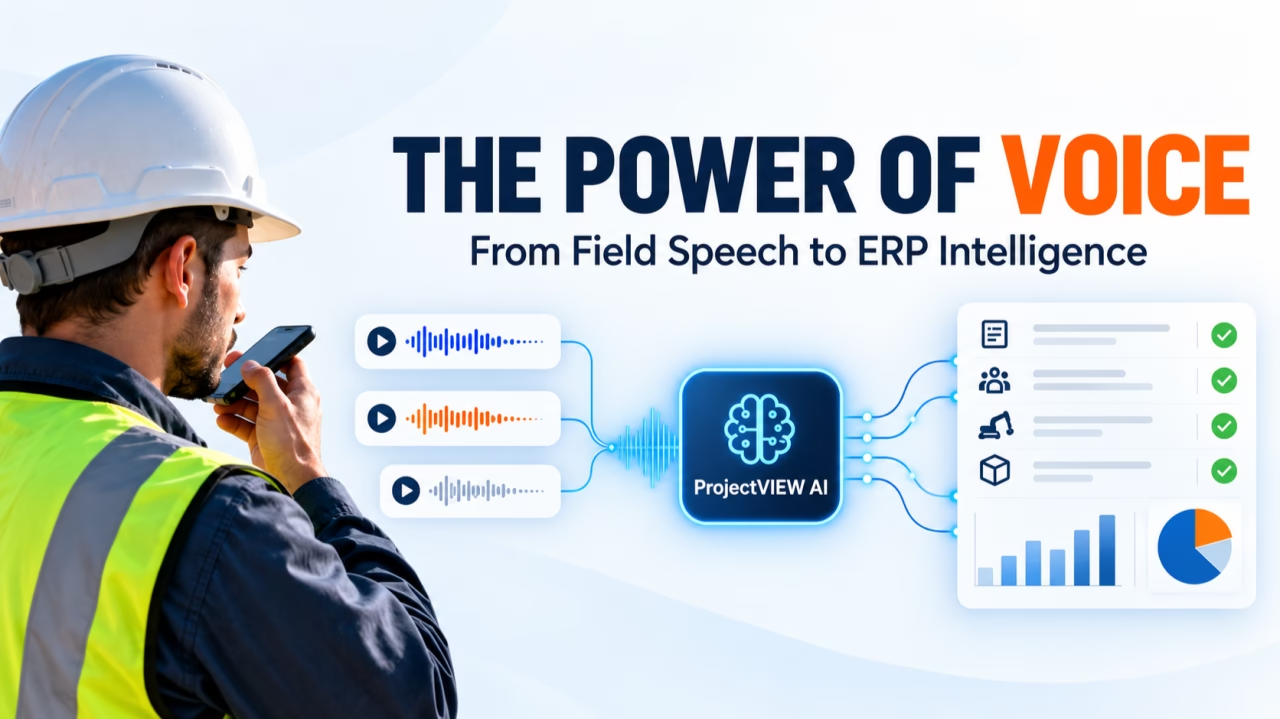
From fragmented field conversations to structured enterprise intelligence: why voice-first AI could fundamentally change how construction sites, shipyards, mines and offshore operations capture and control reality.
The Future of ERP Is Not Another Screen. It Is an Operating System That Listens.
For decades, enterprise software has demanded that people adapt to computers.
Navigate menus. Complete forms. Select codes. Enter quantities. Submit transactions. Update reports.
Yet construction sites, shipyards, mines and offshore platforms do not operate like administrative offices.
Instead, they are dynamic sites spread over wide areas. There, engineers, supervisors, foremen and equipment operators make observations and decisions all day while they do physical work.
The challenge is not a lack of operational information. It is the inability to capture that information accurately, consistently and close to the moment it occurs.
So this is where voice-first AI and headless ERP operations introduce a different approach.
With DANAOS ProjectVIEW AI, field personnel can use natural speech to document activities and operational events in short voice recordings. As a result, they do not need to stop their normal workflows to navigate complex ERP interfaces.
Then AI transforms these fragmented observations into structured information. It also identifies their operational context and directs the relevant data into the correct ProjectVIEW ERP fields and workflows.
The objective is not simply to convert speech into text. It is to convert spoken observations into verified, actionable enterprise data.
1. What Is Headless ERP, and Why Does Voice Change Everything?
A headless operating approach separates the enterprise’s business logic and data processing from the user interface. The interface is only the layer that people use to interact with the system.
In conventional ERP interactions, users must navigate screens and forms to create a transaction.
In a headless, voice-first model, however, people can start those interactions in natural language. Meanwhile, the underlying ERP still enforces its established data structures, permissions, calculations and business rules.
Therefore, the distinction is fundamental:
- Traditional ERP: People translate reality into software fields.
- Voice-first ERP: People describe reality, while AI translates their observations into software-ready information.
ProjectVIEW ERP already provides the operational backbone for this approach. For example, it includes an integrated project data environment, role-based workflows and a standards-based API framework.
In addition, ProjectVIEW AI adds the intelligence layer. This layer interprets natural language and connects human observations with that structured environment.
However, this does not eliminate the ERP interface. Instead, it makes the interface optional for many routine reporting tasks. Conventional interfaces stay in place for supervision, verification, exception handling and approvals.
Headless operation is not the absence of control. It is the removal of unnecessary interaction complexity.
2. From Dispersed Voice Recordings to a Unified Daily Operational Record
How does a site engineer use voice reporting during the day?
For example, consider a site engineer who supervises several activities on a major infrastructure project. Throughout the working day, the engineer uses ProjectVIEW AI to capture brief observations whenever an operational event occurs.
08:10 — Workforce deployment
“Twelve carpenters and six steel fixers started work on the foundation structures in Zone B.”
10:45 — Equipment interruption
“Excavator EX-204 stopped because of a hydraulic problem. We have notified maintenance.”
13:20 — Materials and progress
“We placed thirty-five cubic metres of concrete in foundation section F3. The planned quantity for today was fifty cubic metres.”
15:40 — Operational constraints
“The subcontractor could not complete the remaining reinforcement because the material delivery arrived late.”
Each recording is an independent observation.
It may occur minutes or hours after the previous one. It may also concern a different activity, resource or subcontractor.
As a result, there is no need to construct a complete daily report while standing in the field.
Instead, ProjectVIEW AI assembles a structured operational picture from multiple fragmented recordings.
How does ProjectVIEW AI process the recordings?
The AI processing workflow follows six fundamental stages:
- Voice capture: Authorized personnel create short, timestamped recordings through the field application.
- Speech transcription: Speech recognition converts the recordings into searchable text, preserving the original context and available metadata.
- Semantic interpretation: AI identifies activities, locations, quantities, dates, labor resources, machinery, materials, progress and reported disruptions.
- Contextual association: AI then matches the extracted information with the relevant project, Bill of Quantities (BoQ), Work Breakdown Structure (WBS), Cost Codes and resource records.
- Structured ERP population: The interpreted data populates the corresponding ProjectVIEW ERP records and transaction fields, subject to configured validation and authorization requirements.
- Operational reconciliation: ProjectVIEW compares verified actual execution and resource consumption with the project’s approved budget, schedule and operational baseline.
Modern speech-to-text technologies already support capabilities such as batch transcription, language identification, timestamps and speaker differentiation. For example, see the documentation from Microsoft Azure Speech.
The critical differentiator, however, is not the transcription engine.
Instead, it is the enterprise business logic. This logic decides what the spoken information means, where it belongs and how it affects project execution.
3. Why ProjectVIEW’s BoQ–WBS–Cost Code Integration Is Critical
A generic AI transcription application can produce an excellent summary of a construction engineer’s observations.
But a summary is not a controlled ERP transaction.
For example, consider the statement:
“We placed thirty-five cubic metres of concrete in foundation F3.”
First, the enterprise must link this information to the project’s approved scope, schedule, resources and cost baseline. Only then does it become operationally useful.
As a result, ProjectVIEW ERP’s fundamental architecture becomes essential:
BoQ ↔ WBS ↔ Cost Codes
Bill of Quantities (BoQ) — What are we building?
Identifies the contractual or commercial work item, its measurement unit, associated quantities and budgeted resources.
Work Breakdown Structure (WBS) — When and where is the work scheduled?
Associates execution with planned activities, dependencies, durations and scheduled progress, including schedules managed through Oracle Primavera P6.
Cost Codes — How are resources and expenditures controlled?
Associates resource consumption and expenditure with the contractor’s internal cost structure.
ProjectVIEW ERP then connects these three dimensions across the enterprise.
When the system maps and validates field observations correctly, it can reconcile them with planned productivity and budgeted costs. This covers reported work quantities, labor allocation, equipment utilization and materials consumption.
As a result, it enables something substantially more valuable than automated reporting:
A continuous comparison of planned work, consumed resources, executed work and remaining work.
That is the foundation of ProjectVIEW’s Actual vs. Budgeted Cost Control methodology.
In short, AI makes it easier to capture operational observations. ProjectVIEW then makes those observations economically and operationally meaningful.
4. Voice-Driven ERP Across Construction, Shipyards, Mining and Offshore Operations
Voice-first field reporting is especially valuable where activities spread across large areas. It also helps where operational staff cannot easily use keyboards or lengthy digital forms.
Construction and Infrastructure
Site engineers and foremen can document quantities installed, labor deployment, equipment utilization, material shortages, productivity constraints and requests for inspection.
As a result, these observations support construction daily logs, progress measurement and project cost control.
Shipbuilding and Ship Repair
Supervisors can record fabrication progress, welding activities, equipment installation, repair findings, inspection observations and work interruptions. This applies across different vessels, workshops and dry docks.
The structured records then help associate yard execution with work packages, resources, project budgets and maintenance or production activities.
Mining and Quarrying
Field supervisors can document excavation and production activities, hauling operations, equipment downtime, maintenance events, workforce allocation and operational constraints.
In addition, these observations can complement machine telemetry and production measurements. They give more context for machinery utilization and operational cost analysis.
Marine and Offshore Construction
Personnel on vessels, offshore structures and marine construction sites can capture work progress and equipment status. They can also record weather-related interruptions, material movements and operational events.
When ProjectVIEW’s project-centric environment integrates this information, it can support progress tracking, resource control and timely escalation of operational deviations.
Across all these industries, therefore, the principle remains the same:
The closer information capture occurs to physical execution, the less the organization must rely on reconstructing the past.
5. From Voice Transcription to AI-Driven Cost Control
The real value emerges when voice-generated records become part of a connected operational data environment.
For example, suppose a field engineer reports that a concrete placement activity achieved only 70% of its planned daily quantity. However, equipment and labor resources stayed on the activity for the full shift.
Once verified and linked to the correct project activity, the observation then becomes an input to a much broader analysis.
ProjectVIEW ERP can compare reported and approved progress with resource transactions, budgeted productivity, schedule requirements and actual costs.
The AI layer can then help investigate the cause. For example, the deviation may reflect reduced productivity, equipment downtime, delivery delays, unforeseen site conditions or another operational constraint.
As a result, this information can help identify risks to project performance earlier.
It can also contribute to more complete supporting documentation for contractual variations, delay investigations and claims. However, voice recordings alone do not establish contractual entitlement or certified progress.
This is an important distinction.
AI should not invent operational certainty from an unverified observation.
For example, a team may need to check a recorded quantity against approved measurements. Similarly, equipment downtime may require confirmation through machinery records or telemetry. Finally, financially consequential transactions must follow authorized workflows.
In other words, the objective is not unrestricted automation.
It is faster data capture, intelligent classification and controlled execution.
This approach also follows the trustworthiness principles in the NIST AI Risk Management Framework.
6. Why Voice-First ERP Could Transform Enterprise Productivity
Traditional digital transformation has focused primarily on replacing paper documents with electronic forms.
But digital forms can still impose substantial administrative work on the people responsible for producing physical results.
Voice-first interactions, however, change that relationship.
First, engineers can spend more time supervising works. Second, foremen can document events as they occur. Third, project managers can receive operational information sooner. Meanwhile, administrative teams spend less time transcribing handwritten notes or consolidating disconnected reports.
Also, the potential benefits extend beyond convenience.
For example, more timely reporting can make daily records more complete and help teams detect deviations faster. It can also improve the inputs for cost forecasting and project performance management.
Crucially, voice can also capture knowledge that conventional forms often miss. Examples include the reasons behind a delay, the circumstances of an equipment failure, the sequence of site events or the conditions that affect productivity.
The people closest to execution often know these details, but the details never become part of the enterprise’s structured knowledge.
ProjectVIEW AI therefore provides a way to capture these observations and connect them to the relevant operational records.
Finally, teams should measure the effectiveness of this approach with practical indicators. These include reporting latency, completeness of daily logs, transcription accuracy, validated transaction rates, user adoption and the speed of cost-deviation detection.
7. The Evolution from ERP Data Entry to an Intelligent Operating Environment
The long-term transformation is larger than voice recognition.
In fact, voice is only one form of interaction within a broader AI-enabled operating environment.
Over time, the same enterprise can combine field speech with images, videos and documents. It can also add machinery telemetry, sensor measurements, drone observations and existing ERP transactions.
Each contributes a different dimension of operational evidence.
Through the ProjectVIEW ecosystem, AI can interpret this information against the same project structures and business rules. As a result, the data does not stay isolated in disconnected applications.
This is the architectural direction behind ProjectVIEW OS:
ProjectVIEW ERP — The Process and Data Layer
The system of record that manages structured data, transactions, resources, budgets, permissions and approvals.
ProjectVIEW AI — The Intelligence and Automation Layer
The AI environment that interprets unstructured information, provides contextual reasoning and supports purpose-specific automation.
Together, they establish the foundation for a more intelligent, project-centric operating environment.
Read more: ProjectVIEW OS — The Operating System for the BUILD World.
8. The Most Important Question: Can Your ERP Understand Reality as It Happens?
In construction and other capital-intensive industries, competitive advantage depends more and more on speed. In particular, it depends on how quickly companies see the gap between their plans and actual execution.
Enterprise software should not force employees to interrupt productive work merely to communicate what is happening.
Instead, it should be intelligent enough to interpret natural human observations and link them to the correct business context. Then it should transform them into controlled operational information.
That is the opportunity behind voice-first, headless ERP operations.
People speak. AI interprets. ProjectVIEW ERP structures, validates and controls.
And the system can continuously connect verified field information to project scope, time, resources and cost. As a result, the enterprise moves closer to an essential objective:
Capturing operational reality while there is still time to act on it.
Therefore, the number of screens users can access will not define the next generation of construction ERP.
Instead, the test is how well the operating system understands the work in progress. Just as important is how reliably it connects that reality to business decisions.
The power of voice is not simply making ERP easier to use. It is making project execution easier to understand, control and optimize.