
AI in construction delivers the greatest productivity gains when it operates inside the workflows where work actually happens.
The real opportunity is not simply adding a chatbot to an ERP system.
It is combining AI with structured, integrated construction data—connecting the Bill of Quantities (BoQ), Work Breakdown Structure (WBS), Cost Codes, resources, procurement, subcontractors, machinery, contracts, progress and actual site transactions.
This is the direction of ProjectVIEW ERP + AI: moving from a system that records transactions toward an intelligent operational environment that can assist, explain, automate, predict and eventually act across the project lifecycle.
ProjectVIEW already provides the underlying project-centric data structure required for this approach. Its integration of BoQ, WBS and Cost Codes connects budget, schedule and actual project execution, while daily site transactions feed cost and progress information back into the system.
Where can ProjectVIEW ERP + AI increase productivity?
1. AI-Assisted User Training
Traditional ERP training is usually front-loaded: users attend training sessions, receive manuals and are then expected to remember how hundreds of processes work.
AI can make training continuous and contextual.
An AI assistant (AI tool) embedded within ProjectVIEW can explain what a screen does, guide a user through a process, answer questions about the next step and provide assistance at the moment it is actually needed.
Instead of asking:
“Where is that function?”
or
“How do I create this transaction?”
the user receives assistance directly within the working environment.
The result is potentially faster onboarding, fewer support requests and greater ERP adoption.
2. AI-Assisted Data Input
AI can reduce one of the largest productivity drains in enterprise systems: manual data entry.
Rather than forcing users to populate every field manually, AI can interpret documents, previous transactions, project structures and contextual information to propose relevant values.
The user remains responsible for validation and approval, but much of the mechanical input can be reduced.
3. AI Workflow Assistance — Directly on Screen
ERP productivity is not only about completing transactions faster. It is also about knowing what needs to happen next.
AI-assisted workflows can provide contextual, on-screen guidance such as:
- recommended next actions,
- missing information,
- pending approvals,
- related documents,
- unusual values,
- workflow dependencies,
- relevant historical transactions,
- potential risks or exceptions.
Instead of users adapting themselves to the software, the software increasingly assists users through the process.
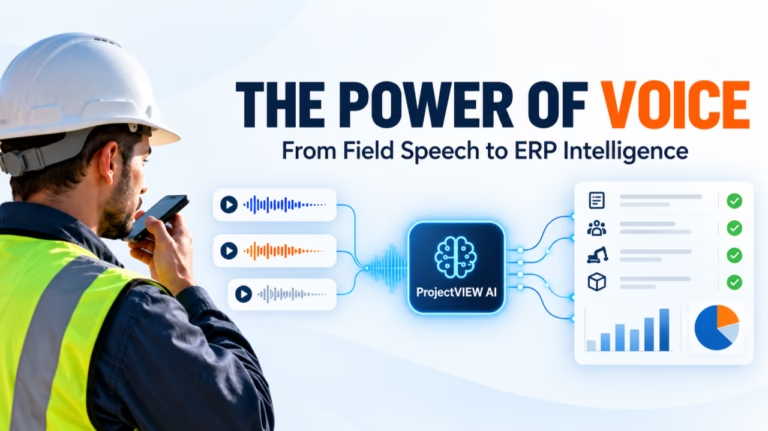
4. Speech-to-Text Daily Construction Log Generator
Daily site reporting remains heavily dependent on manual input.
An engineer, supervisor or foreman should increasingly be able to speak rather than type.
For example:
“Concrete pouring completed at Zone B. 18 workers deployed. Excavator EX-04 operated for six hours. Approximately 80% of today’s planned quantity was completed. Two hours were lost waiting for material delivery.”
AI can transform that spoken input into a structured Daily Construction Log, extracting activities, quantities, manpower, machinery, delays, observations and progress information for user review.
This could substantially reduce administrative effort while improving the speed at which site reality becomes enterprise data.
5. Automated Daily Site Reporting
Once field information is captured digitally, AI can help structure and summarize daily construction activity.
ProjectVIEW already supports daily site transactions covering areas such as progress, employees and machinery, which can feed project cost and budget monitoring.
AI can make this information easier to capture, interpret and communicate.
6. AI-Assisted Estimation and Tendering
Estimators should not have to start every tender from zero.
ProjectVIEW already supports BoQ structures, Cost Recipes, historical pricing, resources, productivity, waste, inflation, overheads, risk and what-if scenarios.
AI can build on this structured historical knowledge to help estimators identify comparable items, retrieve previous costs, suggest relevant Cost Recipes and highlight unusual assumptions.
The objective is not to replace the estimator.
It is to give the estimator a much stronger starting point.
7. AI-Assisted Cost Recipe Generation
A BoQ item is ultimately delivered through a combination of materials + labor + machinery + subcontractors + productivity.
AI can analyze previous projects and Cost Recipes, generalize them and associate them to the BoQs to suggest appropriate resource combinations, productivity assumptions and historical benchmarks.
Estimators can then validate and adjust these recommendations rather than repeatedly reconstructing similar resource structures.
8. Faster Procurement Decisions
Procurement teams routinely spend considerable time collecting, organizing and comparing commercial information.
ProjectVIEW already provides workflows covering material requests, requisitions, RFQs, quotation comparison, supplier evaluation, supplier selection and purchase orders.
AI can assist by comparing quotations, historical prices, supplier performance, lead times and commercial conditions—and by highlighting anomalies that require human attention.
9. AI Procurement Anomaly Detection
Instead of relying exclusively on someone noticing that a quotation looks unusual, AI can continuously look for exceptions.
Why is this price significantly higher than the historical rate?
Why has the same material increased sharply between two projects?
Why is a supplier quotation substantially outside the range of competing bids?
The objective becomes management by exception rather than manually reviewing everything.
10. Intelligent Cost Control
This is where integrated ERP data becomes particularly important.
AI should not analyze cost independently from physical project execution.
ProjectVIEW connects the BoQ ↔ WBS ↔ Cost Codes, creating a structure through which budget, schedule, resources and actual execution can be evaluated together.
This enables AI to ask a much more valuable question:
Does the cost and resource consumption actually justify the progress being reported?
11. Continuous Earned Value Analysis
Reporting that an activity is “50% complete” tells management very little by itself.
The real question is whether quantity, time, cost and resource consumption are aligned.
AI operating over ProjectVIEW’s integrated project structure can continuously analyze these relationships and identify deviations much earlier.
This turns Earned Value principles from a periodic reporting exercise into a potentially continuous operational control mechanism.
12. Predictive Cost Overrun Detection
Traditional reporting explains what has already happened.
AI can help identify what may happen next.
By examining actual cost, commitments, progress, resource consumption, procurement activity, productivity and remaining work, AI can help identify developing patterns that could result in cost overruns.
That gives management something far more valuable than another historical dashboard:
time to intervene.
13. AI Early-Warning System
ProjectVIEW + AI can continuously monitor operational data for exceptions such as declining productivity, unusual resource consumption, procurement delays, cost deviations, machinery issues or workflow bottlenecks.
Instead of managers searching through hundreds of KPIs, the system can surface the exceptions that deserve attention (situational awareness)
14. AI-Assisted Labor Productivity Analysis
ProjectVIEW can associate labor resources and productivity with project activities and costing structures.
AI can build on this information to compare planned versus actual productivity, identify deteriorating production rates and benchmark similar activities across projects.
15. Machinery Utilization and Predictive Maintenance
Idle machinery costs money.
Poorly maintained machinery costs even more.
ProjectVIEW already supports machinery requests, allocation, utilization, availability, fuel, maintenance and cost analysis.
AI can analyze this operational history to improve utilization planning, identify abnormal patterns and support predictive maintenance decisions.
16. Intelligent Resource Allocation
AI can help determine whether labor, equipment and materials are being deployed where they create the greatest operational value.
Instead of viewing resources independently, they can be analyzed against planned quantities, WBS activities, production rates and cost expectations.
17. AI-Assisted Subcontractor Management
ProjectVIEW connects subcontractor procurement with contracts, certificates, deductions, Cost Codes and accounting processes.
AI can assist teams by summarizing subcontractor performance, identifying certification inconsistencies, comparing progress with claims and highlighting contractual or commercial exceptions requiring attention.
18. Faster Approval Workflows
Approvers frequently spend more time understanding a transaction than approving it.
AI can summarize:
What is being requested? Why is it required? What is the financial impact? What was originally budgeted? What supporting documents exist? Is anything unusual?
The manager can therefore concentrate on the decision rather than searching for the information required to make it.
19. AI Document Intelligence & Contract Management
Construction and capital projects generate enormous volumes of documents across their lifecycle—contracts, subcontracts, RFQs, quotations, purchase orders, variations, RFIs, technical submittals, correspondence, certifications, claims and project records.
AI can help classify, summarize, extract and retrieve information from this documentation, transforming the traditional document repository from passive storage into searchable and actionable corporate knowledge.
But the opportunity goes considerably further than document search.
When AI document intelligence is connected with ProjectVIEW ERP’s operational and commercial data, it can support AI-assisted contract management. The system can analyze contractual clauses, obligations, commercial terms, scope boundaries, payment conditions, milestones, warranties, penalties, notice requirements and other contractual provisions—and relate them to the transactions and events occurring during project execution.
AI can also help identify contractual inconsistencies and potential commercial gaps across related documents. For example, it can flag conflicting provisions between a main contract and subcontract, identify differences between an RFQ, supplier quotation and resulting Purchase Order, or highlight where a variation, certification or project instruction may not align with the underlying contractual terms.
Most importantly, AI can help identify potential contractual “loopholes,” weak contractual bridges and missing links between documents and processes—areas where responsibilities, scope, commercial conditions or obligations may not flow consistently from one contractual layer to another.
This enables ProjectVIEW ERP + AI to support teams in answering questions such as:
- Does this subcontract properly reflect the obligations contained in the main contract?
- Are there conflicting clauses, dates, payment terms or responsibilities across related documents?
- Has a contractual obligation been translated into the corresponding operational workflow?
- Does this Purchase Order comply with the commercial conditions established during the RFQ and quotation process?
- Is there a contractual basis supporting this variation or additional cost?
- Are notice periods, milestones, warranties, guarantees or other contractual obligations approaching?
- Could a missing contractual bridge expose the company to commercial or claims risk?
The objective is not to replace legal or contract-management professionals. It is to give them an AI-assisted contractual intelligence layer capable of reviewing large volumes of interconnected project information, surfacing inconsistencies and exceptions for professional review.
In this way, document management evolves into something much more valuable:
Documents → Knowledge → Contract Intelligence → Risk Detection → Action.
20. Natural-Language ERP Search
Users should increasingly be able to ask the ERP directly:
“Which materials are delaying Project A?”
“Show me BoQ items where actual productivity is below estimate.”
“Which purchase orders exceed their original budget?”
“Which machinery has the highest maintenance cost this quarter?”
“Summarize today’s major project exceptions.”
The user asks a business question. AI determines where the relevant information exists.
21. Automatic Management Reporting
AI can help generate daily, weekly and monthly management summaries from live ERP data.
But the productivity gain goes beyond automatically creating a report.
AI can help explain what changed, why it matters and where management attention may be required.
22. Cross-Project Benchmarking
Enterprise contractors possess enormous operational knowledge—but much of it remains trapped inside individual projects.
AI can compare productivity, cost, procurement, resource utilization and performance patterns across projects.
Every completed project can therefore contribute intelligence to the next one.
23. Corporate Knowledge Preservation
When an experienced estimator, procurement manager, project manager or engineer leaves an organization, years of practical knowledge can leave with them.
A structured ERP combined with AI creates an opportunity to convert historical transactions, decisions and project outcomes into reusable institutional knowledge.
24. AI-Assisted Forecasting
Forecasting can evolve beyond manually updating spreadsheets.
AI can continuously evaluate progress, commitments, productivity, remaining quantities and historical performance to support forecasts for cost at completion, resource requirements, procurement demand and potential schedule pressure.
25. AI-Powered What-If Scenarios
Management should be able to explore questions such as:
“What happens to our margin if steel increases by 8%?”
“What happens if productivity falls by 10%?”
“What if this subcontract package is delayed by three weeks?”
“What happens if we increase the equipment fleet?”
ProjectVIEW already supports estimating scenarios and what-if analysis. AI can make these scenarios faster to formulate and easier for decision-makers to interrogate.
26. Specialized AI Agents by Business Function
Ultimately, enterprise AI does not need to be one generic assistant.
Different processes require different intelligence.
ProjectVIEW’s AI environment can evolve around purpose-specific agents such as Estimator Agent, Procurement Agent, Cost Control Agent, Project Manager Agent, Site Agent, Contract Agent, Plant & Machinery Agent, CFO Agent and Executive Management Agent.
Each agent operates within its business context while drawing intelligence from the same integrated project data environment.
The Productivity Equation: ERP + AI + Integrated Construction Data
There is an important distinction.
AI alone does not solve fragmented construction processes.
If estimating sits in one application, scheduling in another, procurement somewhere else, site reporting in spreadsheets and finance in a disconnected ERP, AI inherits the same fragmentation.
The stronger model is:
ProjectVIEW ERP creates the structured operational data. Integration creates the context. AI converts that context into productivity.
ProjectVIEW’s underlying BoQ ↔ WBS ↔ Cost Codes ↔ Resources ↔ Actual Transactions architecture gives AI something extremely valuable: a structured representation of how a construction business planned to execute a project and what is actually happening during execution.
That opens the door to a new generation of construction ERP.
Not simply a System of Record.
But a System of Assistance, Intelligence and Action.
FAQ: AI and Construction ERP
How can AI improve construction ERP productivity?
AI can reduce manual data entry, assist users on screen, generate site reports from speech, analyze costs and productivity, summarize documents, accelerate procurement comparisons, identify anomalies and provide earlier warnings from live project data.
Can AI automate daily construction reporting?
Yes. Speech-to-text and AI-assisted data extraction can transform spoken field observations into structured daily construction logs containing progress, labor, machinery, quantities, delays and other site information for user validation.
How can AI improve construction cost control?
Its greatest value comes when cost is connected with physical progress. By analyzing BoQ quantities, WBS activities, Cost Codes, resources, actual transactions and progress together, AI can identify deviations that isolated financial reporting may miss.
Will AI replace construction professionals?
The more immediate opportunity is augmentation. AI reduces repetitive administrative work, accelerates information retrieval and highlights exceptions, while engineers, estimators, procurement professionals, project managers and executives remain responsible for professional and commercial decisions.
Why does integrated ERP data matter for construction AI?
AI needs context. When cost, schedule, quantities, resources, procurement and site execution are disconnected, the intelligence is fragmented as well. Integrated project data allows AI to reason across the relationships that actually determine project performance.
The future of construction productivity will not come from asking people to work faster.
It will come from eliminating unnecessary work, making knowledge instantly accessible, identifying deviations earlier and giving every professional intelligent assistance exactly where the work happens.
That is the productivity opportunity behind ProjectVIEW ERP + AI.