
The construction, mining and shipbuilding industries are under pressure—from regulators, investors, and society—to become cleaner, more transparent, and more accountable.
But here’s the uncomfortable truth: Most companies still measure ESG after the fact.
Spreadsheets. Static reports. Fragmented data.
That’s not ESG management. That’s ESG storytelling.
If complex, project-based industries is to become truly sustainable, ESG must shift from reporting to real-time operational intelligence.
And that requires something fundamentally different: A system that sees everything.
From ERP to ESG Intelligence Platform
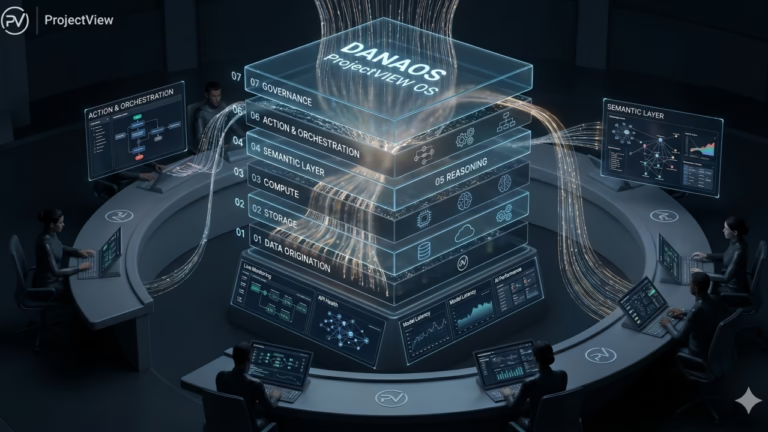
Modern construction ERP systems—when properly architected—are no longer just transactional tools. They are operational intelligence platforms.
ProjectVIEW ERP is built exactly on that principle.
By aligning every process with Time (WBS), Cost (BoQ), and Execution, the system continuously captures, benchmarks, and evaluates real-time operations across projects .
This creates something far more powerful than dashboards:
👉 A living digital twin of operations 👉 A continuous “reality check” mechanism 👉 A single source of truth across all stakeholders
When AI is layered on top, the system evolves into what can only be described as:
The MRI of the Company
Just like an MRI scans the human body and detects anomalies before symptoms appear, an AI-powered ERP scans:
- Processes
- Transactions
- Patterns
- Behaviours
And identifies:
- Deviations
- Inefficiencies
- Compliance risks
- ESG violations
Not after damage is done—but as they emerge.
ESG Starts with Data Integrity, Not Reporting
Before ESG becomes a KPI, it must become data discipline.
ProjectVIEW ERP enforces this by:
- Digitising all workflows (procurement, subcontracting, site operations)
- Logging every transaction and user action
- Embedding approvals and compliance checkpoints
- Providing real-time alerts and anomaly detection
The system’s architecture ensures:
- Full traceability
- Role-based accountability
- Continuous monitoring
This is not optional—it is the foundation of Governance (G).
Centralized access control, workflows, and detailed activity logging ensure that every action is recorded and auditable, enabling procedural compliance and transparency .
Environmental (E): From Carbon Estimates to Real Footprint Control
Most companies estimate environmental impact. Few actually control it.
With ProjectVIEW ERP + AI, environmental KPIs become operational.
Example 1: Supply Chain Carbon Footprint (SCM)
- Procurement module tracks: Material origin Supplier performance Transportation routes
- AI identifies: High-emission suppliers Inefficient logistics patterns Over-ordering or waste
Outcome:
- Reduction in embodied carbon
- Optimization of sourcing decisions
- ESG scoring per supplier
Example 2: Machinery & Fuel Consumption
- Machinery module logs: Fuel usage Maintenance cycles Idle time
- AI detects: Abnormal fuel consumption Underutilized equipment Maintenance negligence
Outcome:
- Lower emissions
- Reduced operational waste
- Predictive maintenance instead of reactive repairs
(Yes, even machinery allocation and fuel tracking are part of daily monitored operations in the system)
Example 3: Material Waste Control
- Real-time comparison: Budgeted vs actual consumption
- AI flags: Overconsumption patterns Site-level inefficiencies
Outcome:
- Waste minimization
- Better BoQ accuracy
- Lean construction execution
Social (S): Turning Workforce Data into Responsibility
The “S” in ESG is the least digitized—and the most misunderstood.
ProjectVIEW ERP changes that by structuring workforce data across:
- HR
- Site operations
- Subcontractors
- Productivity tracking
Example 1: Labor Conditions & Compliance
- Track: Working hours Contracts Certifications
- AI detects: Overwork patterns Compliance breaches Skill mismatches
Outcome:
- Safer, compliant workforce
- Reduced legal risk
- Improved labor productivity
Example 2: Subcontractor ESG Scoring
- Monitor: Performance Delays Quality issues
- AI identifies: Risky subcontractors Repeated non-compliance
Outcome:
- Transparent partner evaluation
- ESG-based subcontractor selection
Governance (G): From Control to Predictive Compliance
Governance is where most ERP systems claim strength. Few actually deliver predictive control.
ProjectVIEW ERP enforces governance by design:
- Workflow approvals across all processes
- Full audit trails
- Role-based permissions
- Integrated financial and operational controls
But the real shift comes with AI:
Example 1: Procurement Anomaly Detection
- AI scans: Purchase orders Vendor pricing Contract deviations
- Flags: Price anomalies Suspicious patterns Unauthorized approvals
Example 2: Contract & Cost Deviations
- Real-time comparison: Budget vs actual
- AI predicts: Cost overruns Claims risk Cash flow issues
Because ProjectVIEW continuously benchmarks actual vs planned costs and execution, deviations are detected early and corrected before escalation .
Outcome:
- Proactive governance
- Reduced fraud risk
- Strong audit readiness
ESG KPIs Become Native — Not External
The real breakthrough is this:
ESG KPIs are no longer external reports. They are native outputs of daily operations.
With ProjectVIEW ERP, companies can track:
Environmental KPIs
- CO₂ per project / activity
- Fuel consumption per machinery
- Material waste ratios
Social KPIs
- Labor productivity vs safety
- Workforce compliance rates
- Subcontractor ESG scores
Governance KPIs
- Approval cycle times
- Audit trail completeness
- Cost deviation frequency
All generated automatically, in real time.
The Strategic Shift: From Digitalization to Intelligence
Digital transformation in construction has been misunderstood.
It’s not about:
- Moving from paper to software
- Replacing Excel with ERP
It’s about:
👉 Transforming data into intelligence 👉 Transforming operations into measurable systems 👉 Transforming ESG into a controllable outcome
ProjectVIEW ERP—combined with AI—does exactly that:
- It digitizes processes
- Standardizes operations
- Monitors execution
- Detects anomalies
- Enforces compliance
- Generates ESG insights
All within a single, integrated ecosystem.
Final Thought: Clean Construction Is Not a Vision—It’s a System
Sustainability in construction will not come from policies alone.
It will come from systems that:
- See everything
- Understand patterns
- Predict risks
- Enforce discipline
That system already exists.
It’s called an AI-powered construction ERP.
And when implemented correctly, it becomes:
The MRI of your company—continuously scanning, diagnosing, and optimizing every project, every process, and every ESG outcome.