
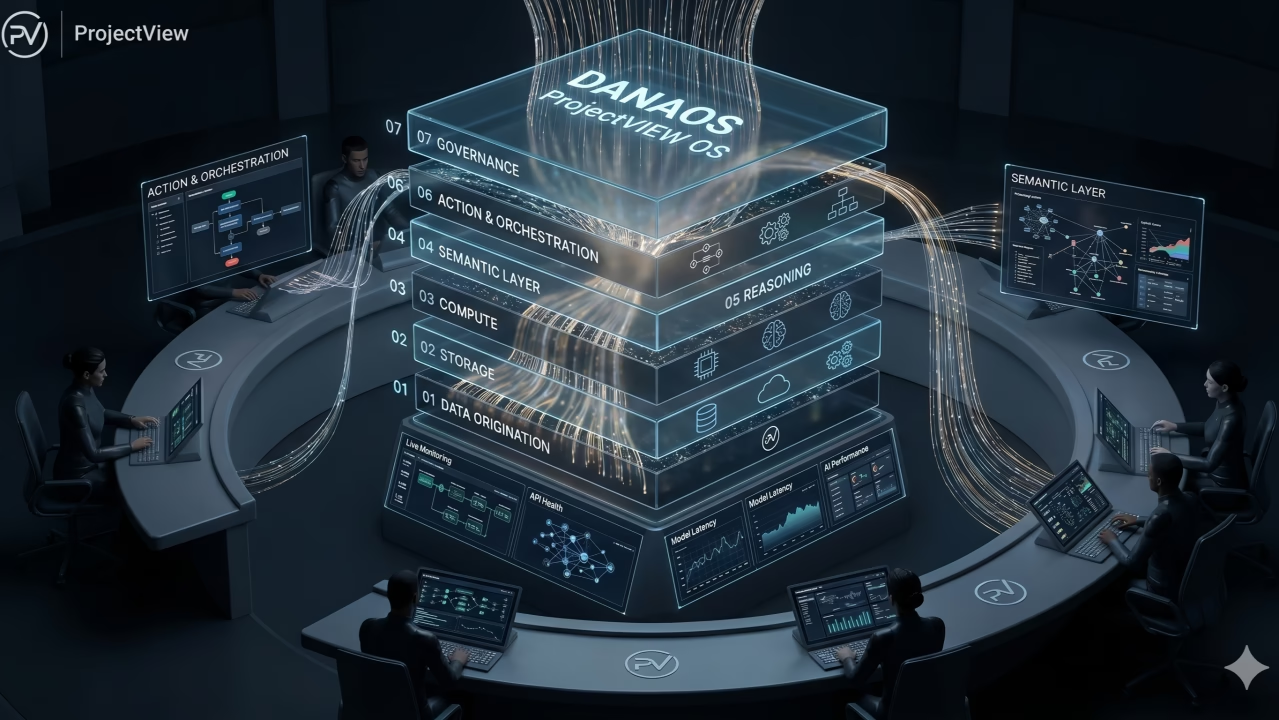
The Hidden Truth: Operational Confidence Is Built on Data Integrity
In enterprise environments—especially for listed companies—confidence is not built on narratives. It is built on data that can be trusted, verified, and defended.
Investors, regulators, auditors, and internal stakeholders are not asking for reports. They are asking for proof:
- Proof that costs are controlled
- Proof that projects are progressing as reported
- Proof that risks are identified and managed
- Proof that financials reflect operational reality
This is where the Enterprise Information System (EIS) becomes mission-critical.
And at the core of that EIS sits the ERP.
ERP as the Foundation of Auditability and Accountability
A properly designed ERP is not just a system of record. It is a system of accountability.
Take Supply Chain Management (Procurement + Logistics)

A system that understands the process end-to-end (project – site – warehouse – sourcing – procurement) it enforces:
1. Auditability
Every transaction, approval, change, and deviation must be:
- Logged
- Time-stamped
- Traceable to a user and process
- Reconstructable at any point in time
Without auditability, financial reporting becomes exposed to risk, and compliance becomes reactive instead of controlled.
Modern enterprise systems must provide detailed user activity logging, controlled access, and full traceability across processes, ensuring that every action can be audited and validated .
2. Accountability
Accountability is not a cultural aspiration. It is a system-enforced mechanism.
A robust ERP:
- Assigns ownership to every process step
- Enforces approval workflows
- Links decisions to roles and responsibilities
- Eliminates ambiguity in execution
In project-based environments, where thousands of micro-decisions affect cost and schedule, this is the only way to maintain control.
3. Consistency
Consistency is what turns data into intelligence.
When processes are fragmented across:
- Excel files
- Standalone tools
- Department-specific systems
…data becomes inconsistent, conflicting, and unreliable.
An enterprise ERP creates:
- Standardized workflows
- Unified data structures
- Cross-departmental alignment
This ensures that:
- Finance sees the same reality as operations
- Procurement aligns with project execution
- Management decisions are based on one version of truth
4. Control
Control is not about restriction. It is about predictability and early intervention.
A strong ERP provides:
- Real-time monitoring of deviations
- Alerts and approval gates for changes
- Continuous comparison of planned vs actual performance
This transforms management from reactive firefighting into proactive control.
The Critical Gap: Why Generic ERPs Fail Project-Based Enterprises
Here’s the uncomfortable truth:
Most ERP systems were not designed for project-based operations.
They were built for:
- Manufacturing (repetitive processes)
- Retail (transactional flows)
- Finance (ledger-centric models)
Project-based industries—construction, shipbuilding, EPC, mining—operate differently:
- Every project is unique
- Costs are dynamic and evolving
- Execution happens across sites, vendors, and stakeholders
- Change is constant, not exceptional
Generic ERPs struggle because they:
1. Lack True Project-Centric Data Models
They cannot natively connect:
- Scope (BoQ)
- Time (WBS)
- Cost (resources, procurement, execution)
Without this integration, data becomes fragmented and disconnected.
2. Produce “Accounting Reality” Instead of “Operational Reality”
Generic systems often reflect:
- What has been booked
- What has been invoiced
But fail to reflect:
- What is actually happening on-site
- What costs are evolving in real-time
- What risks are emerging
This creates a dangerous gap between:
Reported performance vs actual performance
3. Depend on External Tools and Manual Workarounds
To compensate for their limitations, organizations rely on:
- Excel-based estimations
- Disconnected scheduling tools
- Manual cost tracking
This introduces:
- Human error
- Version conflicts
- Lack of traceability
Which directly undermines auditability and accountability.
4. Fail to Capture Momentum and Risk
A project-based company is not defined by its current financials.
It is defined by:
- Its pipeline
- Its cost-to-complete
- Its exposure to change orders
- Its execution efficiency
Generic ERPs cannot model this effectively.
As a result, they fail to provide forward-looking intelligence—the very thing investors and executives rely on.
ProjectVIEW ERP: Engineering Operational Confidence
ProjectVIEW ERP was built differently.
Not as a generic system adapted to projects— but as a project-native Enterprise Information System.
At its core lies a fundamental principle:
Every process is aligned with Time (WBS), Cost (BoQ), and Execution.
This creates a fully integrated environment where:
- Every transaction is linked to a project dimension
- Every cost is contextualised within scope and schedule
- Every deviation is immediately visible and traceable
This unique association:
BoQ ↔ WBS ↔ Cost Codes
enables real-time visibility of Actual vs Budgeted performance, ensuring that data reflects reality—not assumptions .
Building Stakeholder Confidence Through System Design
When an ERP is designed correctly, it doesn’t just support operations. It builds confidence across the entire stakeholder ecosystem.
For Executives
- Real-time visibility into performance and risk
- Reliable forecasts and cost-to-complete insights
For Auditors
- Full traceability of transactions and decisions
- Structured, verifiable data trails
For Regulators
- Compliance through enforced workflows and controls
- Accurate, consistent reporting
For Investors
- Transparency into operational performance
- Confidence that financials reflect reality
From Data to Trust: The Real Role of ERP
At the enterprise level, ERP is not about efficiency alone.
It is about trust.
Trust that:
- Data is accurate
- Processes are controlled
- Risks are visible
- Performance is real
Without this, organizations operate in uncertainty.
With it, they operate with clarity, control, and confidence.
ERP Defines How the Market Perceives Your Business
In project-based industries, your ERP system does more than run your operations.
It defines:
- How accurately you report performance
- How effectively you manage risk
- How confidently stakeholders trust your data
Generic ERPs fall short because they do not understand the nature of project execution.
DANAOS ProjectVIEW ERP bridges that gap— by embedding operational logic, enforcing accountability, and delivering real-time, auditable intelligence.
Because in today’s environment:
If your data cannot be trusted, your business cannot be valued correctly.