))
))
))
))
))
))
))
))


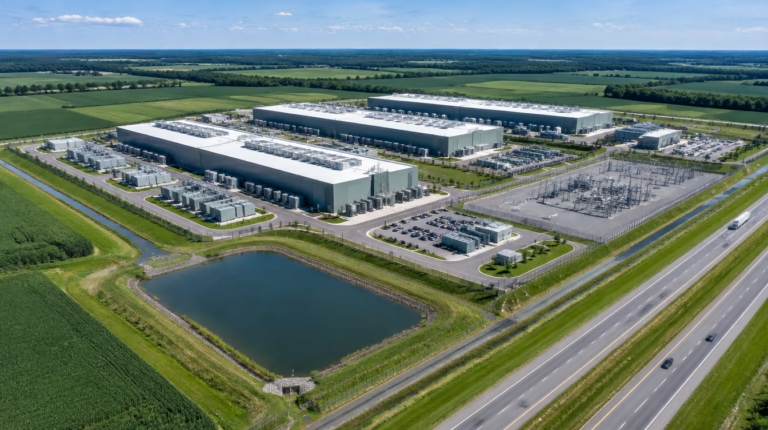
When organizations without a dedicated background in real estate development or construction management undertake data center construction, they often struggle with multiple challenges. Moreover, the absence of appropriate digital tools and common data platforms makes these challenges worse.
1. Constant Changes & Scope Creep
- First, requirements evolve rapidly: hardware specs, cooling tech, security measures, regulatory compliance.
- As a result, frequent design revisions, zoning changes, or shifting standards (e.g. Uptime Institute tiers, energy codes) cause schedule disruption and budget risk .
2. Procurement Complexities
- For example, projects rely on long‑lead equipment (generators, power systems, fiber) with global supply chain constraints and volatile pricing.
- In addition, owners struggle with site-driven modular procurement. They must manage vendor pools and align purchases with project WBS and budgets .
3. Permitting & Regulatory Bureaucracy
- Securing local planning permissions, zoning approvals, and environmental compliance can be slow. This is especially true for non‑developer owners unfamiliar with local jurisdictions.
- Moreover, inconsistent processes across municipalities and shifting regulations add further friction .
4. Strict Timelines & Cost Targets
- Above all, delays can cost millions (lost service revenue, contract penalties).
- In addition, fixed-price contracts and strict schedule SLAs bind contractors, so there is no buffer for error or late deliveries .
5. Complex Multi-Discipline Coordination
- In short, data centers integrate electrical, mechanical (cooling, fire suppression), structural, and IT infrastructure.
- Each trade must align precisely with BIM models, safety standards, and client expectations. As a result, any miscoordination causes delays and rework .
🧩 ProjectVIEW ERP: A Holistic Solution for Every Stakeholder
ProjectVIEW ERP (by DANAOS) is a construction ERP built for project-based industries—including complex data center builds. Consequently, it addresses the key challenges head-on.
How It Helps Owners (especially tech‑based clients)
- Common Data Environment (CDE): A centralized platform keeps project data—designs, BoQs, change orders, RFIs—versioned, permissioned, and accessible. As a result, it improves transparency and reduces confusion .
- Integrated Budget & Cost Tracking: Real-time comparison of budget vs. actuals ties to the WBS/BoQ baseline imported from scheduling tools such as Primavera P6. In this way, it forms a digital backbone for financial clarity .
How Consultants & Designers Benefit
- Change Management Engine: Seamless integration of schedule changes (e.g. from tech spec revisions), linked to cost updates and procurement workflows. This therefore enables rapid traceability and decision-making.
- Role-Based Collaboration: Consultants can also collaborate on documents, designs, QA records, and schedule data in a controlled environment. Thus, they reduce siloed communication .
How Procurement & Materials Teams Gain Control
- Project-Based Procurement Engine: First, purchases begin from the BoQ aligned with the WBS baseline. Then Site‑Item Requests (SIRs) validate materials/services use within the remaining budget, and the system tracks them live .
- Inventory Visibility: The system monitors stock levels, transfers, and site usage in real-time and maps them to specific cost codes. As a result, it eliminates overstock or misordering .
How Contractors and Project Managers Stay on Track
- Earned Value Analysis (EVA): Automatically calculate performance metrics like Cost Performance Index (CPI) or Schedule VAR from real‑time data feeds. Because you need no manual spreadsheets, forecasting becomes more accurate .
- Document & QA Control: An integrated vault tracks designs, subcontractor documents, commissioning records, and inspections alongside progress updates. Consequently, it delivers audit-readiness and reduces rework risks .
Why ProjectVIEW ERP is Ideal for Data Center Projects
- Designed for project-driven sectors like construction, shipbuilding, and energy. It also comes with tight ERP‑PM integration via Primavera and BIM systems .
- Proven at DANAOS implementations, achieving seamless data flow between tendering, operations, procurement, finance, HR, and site execution—all without needing separate platforms.
- Scalable and modular, so it enables phased deployment starting with procurement or cost control modules and expanding over time .
For technology-led owners stepping into data center construction, the risks add up quickly. In fact, navigating changes, procurement bottlenecks, permitting bureaucracy, and tight deadlines can be a perfect storm. ProjectVIEW ERP brings an industry-proven, single-source-of-truth solution that turns complexity into controlled delivery. As a result, it enables all parties—from owners and consultants to procurement and contractors—to work with confidence, precision, and transparency.